
Alfama
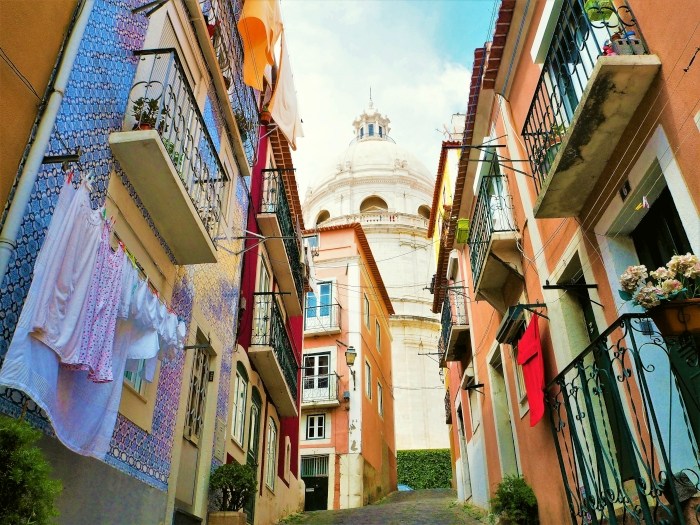
It’s one of the oldest and most typical portuguese neighborhoods in the city of Lisbon, Alfama whose name derives from the Arabic “al-hamma”, that means “source of hot waters, good waters” – is the topic of today’s article.
Its main monuments are the Castle of São Jorge, the Cathedral of Lisbon, the Church of Saint Estevão and the Church of Saint Vicente de Fora. The area is known for its restaurants and fado houses, as for its celebrations of the Santos Populares, especially in the evening of Saint António from the 12th to the 13th of June.
During muslim ruling, between the years of 711 to 1147, you could speak of two Alfamas: a high Alfama and an Alfama of the Sea. The high Alfama was more aristocratic, situated inside the moorish wall, while the Alfama of the Sea was predominantly common folk. In the Middle Ages, the wealthy inhabitants moved to the west, leaving the neighborhood to a population of fishermen and sailorman.
Alfama is mainly known for its relationship with fado, a musical genre of nostalgic sounds, catalogued by UNESCO as Immaterial Cultural Patrimony of Humanity. It is no surprise then, that is in Alfama, that you will find the Museum of Fado and the Mural of Amália Rodrigues, the most popular fado singer, by Vhils.
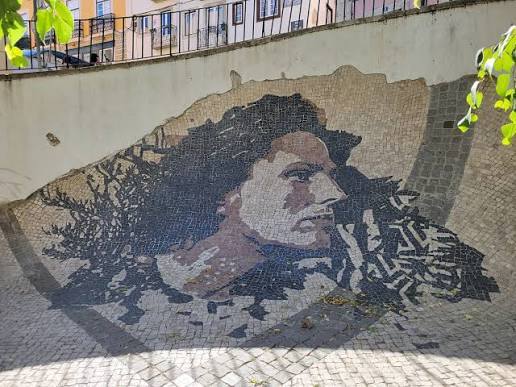
The Museum of Fado is entirely dedicated to fado, offering its visitors a vast collection of historical musical instruments, photographs and much more. Still, fado is everywhere in Alfama, you can find it in every corner, in every street; all you have to do is keep an attentive eye to your surroundings.
It is also in Alfama that you will find Feira da Ladra. With roots that date back to the 8th century, Feira da Ladra took place in multiple locations until it fixed itself in Campo de Santa Clara. Its dedicated, mainly, to the commerce of old merchandise, secondhand objects and craftsmanship. It happens weekly on Tuesdays and Saturdays, from morning to evening.
There are many theories that explain its name: one is related to the fact that many of the objects there were supposedly stolen. Another speculates that it’s due to the lice that could be found in the old merchandise that has the name “ladro”. Still, there are people that say that the name comes from the Parisienne fairs from Middle Age, “Saint-Ladre”, with origin in Saint-Lazare.
There is still much more to discover in Alfama and about it! You can do so by booking one of our Old Town tours! So don’t waste any more time and allow yourself to get immersed in one of Lisbon’s most beautiful and authentic neighborhoods.